bezier
Helper for B |eacute| zier Curves, Triangles, and Higher Order Objects
|linux-build| |macos-build| |windows-build| |coverage|
|pypi| |versions|
|docs| |zenodo| |JOSS|
.. |eacute| unicode:: U+000E9 .. LATIN SMALL LETTER E WITH ACUTE
:trim:
This library provides:
- Support for B |eacute| zier
Curves_ - Support for B |eacute| zier
Triangles_
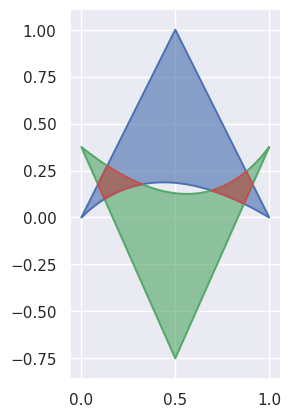
Dive in and take a look!
.. image:: https://raw.githubusercontent.com/dhermes/bezier/main/docs/images/triangles6Q_and_7Q.png
:align: center
Why B |eacute| zier?
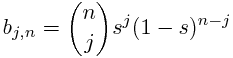
A B |eacute| zier curve (and triangle, etc.) is a parametric curve
that uses the Bernstein basis_:
.. image:: https://raw.githubusercontent.com/dhermes/bezier/main/docs/images/bernstein_basis.png
:align: center
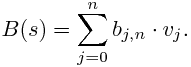
to define a curve as a linear combination:
.. image:: https://raw.githubusercontent.com/dhermes/bezier/main/docs/images/bezier_defn.png
:align: center
This comes from the fact that the weights sum to one:
.. image:: https://raw.githubusercontent.com/dhermes/bezier/main/docs/images/sum_to_unity.png
:align: center

This can be generalized to higher order by considering three, four, etc.
non-negative weights that sum to one (in the above we have the two
non-negative weights s and 1 - s).
Due to their simple form, B |eacute| zier curves:
- can easily model geometric objects as parametric curves, triangles, etc.
- can be computed in an efficient and numerically stable way via
de Casteljau's algorithm_ - can utilize convex optimization techniques for many algorithms (such as
curve-curve intersection), since curves (and triangles, etc.)
are convex combinations of the basis
Many applications -- as well as the history of their development --
are described in
"The Bernstein polynomial basis: A centennial retrospective_",
for example;
- aids physical analysis using finite element methods (
FEM) on
isogeometric models by using geometric shape functions called
NURBSto represent data - used in robust control of dynamic systems; utilizes convexity to
create a hull of curves
.. _retrospective: https://dx.doi.org/10.1016/j.cagd.2012.03.001
.. _Bernstein basis: https://en.wikipedia.org/wiki/Bernstein_polynomial
.. _de Casteljau's algorithm: https://en.wikipedia.org/wiki/De_Casteljau%27s_algorithm
.. _FEM: https://en.wikipedia.org/wiki/Finite_element_method
.. _NURBS: https://en.wikipedia.org/wiki/Non-uniform_rational_B-spline
Installing
The bezier Python package can be installed with pip_:
.. code-block:: console
$ python -m pip install --upgrade bezier
$ python3.12 -m pip install --upgrade bezier
$ # To install optional dependencies, e.g. SymPy
$ python -m pip install --upgrade bezier[full]
To install a pure Python version (i.e. with no binary extension):
.. code-block:: console
$ BEZIER_NO_EXTENSION=true \
python -m pip install --upgrade bezier --no-binary=bezier
bezier is open-source, so you can alternatively grab the source
code from GitHub_ and install from source.
.. _pip: https://pip.pypa.io
.. _GitHub: https://github.com/dhermes/bezier/
Getting Started
For example, to create a curve:
.. code-block:: python
import bezier
import numpy as np
nodes1 = np.asfortranarray([
... [0.0, 0.5, 1.0],
... [0.0, 1.0, 0.0],
... ])
curve1 = bezier.Curve(nodes1, degree=2)
The intersection (points) between two curves can
also be determined:
.. code-block:: python
nodes2 = np.asfortranarray([
... [0.0, 0.25, 0.5, 0.75, 1.0],
... [0.0, 2.0 , -2.0, 2.0 , 0.0],
... ])
curve2 = bezier.Curve.from_nodes(nodes2)
intersections = curve1.intersect(curve2)
intersections
array([[0.31101776, 0.68898224, 0. , 1. ],
[0.31101776, 0.68898224, 0. , 1. ]])
s_vals = np.asfortranarray(intersections[0, :])
points = curve1.evaluate_multi(s_vals)
points
array([[0.31101776, 0.68898224, 0. , 1. ],
[0.42857143, 0.42857143, 0. , 0. ]])
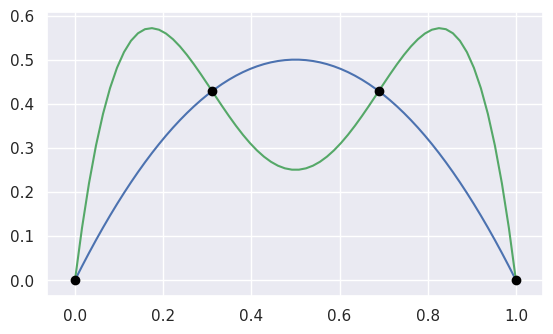
and then we can plot these curves (along with their
intersections):
.. code-block:: python
import seaborn
seaborn.set()ax = curve1.plot(num_pts=256)
_ = curve2.plot(num_pts=256, ax=ax)
lines = ax.plot(
... points[0, :], points[1, :],
... marker="o", linestyle="None", color="black")
_ = ax.axis("scaled")
_ = ax.set_xlim(-0.125, 1.125)
_ = ax.set_ylim(-0.0625, 0.625)
.. image:: https://raw.githubusercontent.com/dhermes/bezier/main/docs/images/curves1_and_13.png
:align: center
For API-level documentation, check out the B |eacute| zier Python
package_ documentation.
Development
To work on adding a feature or to run the functional tests, see the
DEVELOPMENT doc_ for more information on how to get
started.
Citation
For publications that use bezier, there is a JOSS paper_ that can be
cited. The following BibTeX entry can be used:
.. code-block:: rest
@Article{Hermes2017,
doi = {10.21105/joss.00267},
url = {https://doi.org/10.21105%2Fjoss.00267},
year = {2017},
month = {Aug},
publisher = {The Open Journal},
volume = {2},
number = {16},
pages = {267},
author = {Danny Hermes},
title = {Helper for B{'{e}}zier Curves, Triangles, and Higher Order Objects},
journal = {The Journal of Open Source Software}
}
A particular version of this library can be cited via a Zenodo DOI; see
a full list by version_.
.. _JOSS paper: https://joss.theoj.org/papers/10.21105/joss.00267
.. _list by version: https://zenodo.org/search?page=1&size=20&q=conceptrecid:%22838307%22&sort=-version&all_versions=True
License
bezier is made available under the Apache 2.0 License. For more
details, see the LICENSE_.
.. _Curves: https://bezier.readthedocs.io/en/latest/python/reference/bezier.curve.html
.. _Triangles: https://bezier.readthedocs.io/en/latest/python/reference/bezier.triangle.html
.. _package: https://bezier.readthedocs.io/en/latest/python/reference/bezier.html
.. _DEVELOPMENT doc: https://github.com/dhermes/bezier/blob/main/DEVELOPMENT.rst
.. _the LICENSE: https://github.com/dhermes/bezier/blob/main/LICENSE
.. |docs| image:: https://readthedocs.org/projects/bezier/badge/?version=latest
:target: https://bezier.readthedocs.io/en/latest/
:alt: Documentation Status
.. |linux-build| image:: https://github.com/dhermes/bezier/workflows/Linux/badge.svg?branch=main&event=push
:target: https://github.com/dhermes/bezier/actions?query=workflow%3ALinux
:alt: Linux Build (GitHub Actions)
.. |macos-build| image:: https://github.com/dhermes/bezier/workflows/macOS/badge.svg?branch=main&event=push
:target: https://github.com/dhermes/bezier/actions?query=workflow%3AmacOS
:alt: macOS Build (GitHub Actions)
.. |windows-build| image:: https://github.com/dhermes/bezier/workflows/Windows/badge.svg?branch=main&event=push
:target: https://github.com/dhermes/bezier/actions?query=workflow%3AWindows
:alt: Windows Build (GitHub Actions)
.. |pypi| image:: https://img.shields.io/pypi/v/bezier.svg
:target: https://pypi.org/project/bezier/
:alt: PyPI Latest
.. |versions| image:: https://img.shields.io/pypi/pyversions/bezier.svg
:target: https://pypi.org/project/bezier/
:alt: Package Versions
.. |coverage| image:: https://coveralls.io/repos/github/dhermes/bezier/badge.svg
:target: https://coveralls.io/github/dhermes/bezier
:alt: Code Coverage
.. |zenodo| image:: https://zenodo.org/badge/73047402.svg
:target: https://zenodo.org/badge/latestdoi/73047402
:alt: Zenodo DOI for bezier
.. |JOSS| image:: https://joss.theoj.org/papers/10.21105/joss.00267/status.svg
:target: https://dx.doi.org/10.21105/joss.00267
:alt: "Journal of Open Source Science" DOI for bezier







