CALDERA
CALDERA is an automated adversary emulation system that performs post-compromise adversarial behavior within
Windows Enterprise networks. It generates plans during operation using a planning system and a
pre-configured adversary model based on the
Adversarial Tactics, Techniques & Common Knowledge (ATT&CK™) project.
These features allow CALDERA to dynamically operate over a set of systems using variable behavior,
which better represents how human adversaries perform operations than systems that follow
prescribed sequences of actions.
CALDERA is useful for defenders who want to generate real data that represents how an adversary
would typically behave within their networks. Since CALDERA's knowledge about a network is gathered
during its operation and is used to drive its use of techniques to reach a goal, defenders can get a glimpse into
how the intrinsic security dependencies of their network allow an adversary to be successful. CALDERA
is useful for identifying new data sources, creating and refining behavioral-based intrusion detection analytics,
testing defenses and security configurations, and generating experience for training.
BlackHat Europe 2017 presentation slides: CALDERA - Automating Adversary Emulation
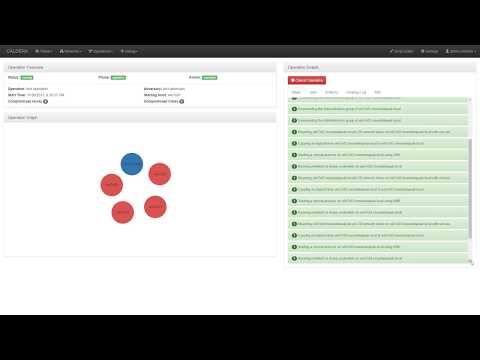
Demo
Requirements
CALDERA only supports Windows Enterprise networks that are configured as a
Windows Domain. This is because the techniques and
tactics currently built into CALDERA are unique to Windows domains. Despite this, the CALDERA server can
be installed on either Linux or Windows.
See Requirements for more detailed information.
Installation
Detailed installation instructions are included in the Installation documentation.
Documentation
Documentation is available on Read the Docs
Architecture
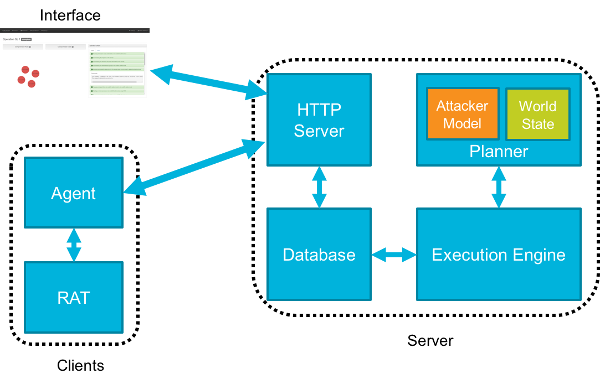
CALDERA consists of:
- Server
- Planner - Decision engine allowing CALDERA to chose actions
- Attacker Model - Actions available based on ATT&CK
- World Model - Representation of the environment
- Execution Engine - Drives actuation of techniques and updates the database
- Database - Stores knowledge learned about the environment
- HTTP Server
- Planner - Decision engine allowing CALDERA to chose actions
- Clients
- Agent - Client on endpoint systems used for communication
- RAT - Remote access tool used during operations to emulate adversary behavior
Planning System
CALDERA's planning system allows it to "decide" the next best action to take based upon its current
knowledge of the environment and the actions available at a given point in time. CALDERA's attacker model is
represented by pre-configured ATT&CK-based techniques that have been logically encoded
with pre and post conditions allowing CALDERA to chain together sequences of actions to reach an
objective state.

The system follows this algorithm:
- Update the world state
- Figure out all valid actions to execute
- Construct plans that lead off with those actions, chain actions together by leveraging model
- Run heuristic to determine best plan
- Execute the first action in the best plan
- Repeat
Extensibility
New techniques can be added to CALDERA without having to recompute new decision models because of how techniques are
logically defined. It is encouraged to develop new techniques and variations of techniques to better represent the
variations in how adversaries can behave and contribute them back to the project.
Considerations and Limitations
The path chaining problems CALDERA's planning system is designed to solve are computationally intensive.
While CALDERA's server does not have hardware requirements beyond a typical software developer's system, there are
limitations on the number of systems CALDERA can operate over before the planning time between actions will cause
significant delays or the system to fail. Thus it is not recommended that CALDERA be used against sets of systems
larger than 20.
CALDERA performs real actions on systems when operating. If it is being used in a production network, beyond an
isolated lab network, then care should be taken to inform any network security staff, administrators, or users who
may be impacted prior to using CALDERA to deconflict any issues that may arise.
CALDERA uses other open source tools as part of its repository of techniques. Some of these tools
are categorized as penetration testing or security auditing tools. See Security for
more information.
CALDERA does not use or repurpose known adversary malware. It focuses on using adversary behavior documented
within ATT&CK, which can be employed in many different ways regardless of specific pieces of malware an adversary
may use.
CALDERA does not emulate adversary command and control (C2) channels. The variation in adversary C2 protocols
and communication methods is vast and is considered out of scope.
CALDERA also does not use software exploitation. There are many free and commercial tools that can be used
to assess software weakness and exploitability. CALDERA should not be used for this purpose.
Research
CALDERA is a MITRE research project and is an implementation of some of the ideas described in the following papers:
Intelligent, Automated Red Team Emulation
Analysis of Automated Adversary Emulation Techniques
Related MITRE Work
BRAWL Game - Data set created by the BRAWL project representing
one CALDERA operation with data collected by Microsoft Sysmon and other sensors.
CASCADE - Prototype blue team analysis tool to automate investigative work.