JE
jeongwhanchoi/GFSA
"Graph Convolutions Enrich the Self-Attention in Transformers!" NeurIPS 2024
Graph Convolutions Enrich the Self-Attention in Transformers!




Jeongwhan Choi1*,
Hyowon Wi2*,
Jayoung Kim2,
Yehjin Shin2,
Kookjin Lee3,
Nathaniel Trask4,
Noseong Park2,
1Yonsei University, 2KAIST, 3Arizona State University, 4University of Pennsylvania
📢 News!
- Mar 3, 2025: 📰 alphaXiv has generated a blog post of our paper!
- Dec 11, 2024: We presented our work at NeurIPS 2024! 🚀
- 🖼️ See our poster
- 📄 Read the paper
- 📽️ Watch the video presentation and slides
- Dec 3, 2024: 🏆 With this work, Jeongwhan Choi and Hyowon Wi have won a 2024 Qualcomm Innovation Fellowship!
- Dec 9, 2024: Our source code is available now!
- Oct 23, 2024: 🏆 With this work, Jeongwhan Choi and Hyowon Wi were qualified as a Qualcomm Innovation Fellowship Finalist in the field of AI/ML.
- Sep 26, 2024: Our paper has been accepted to NeurIPS 2024! 🎉
Introduction
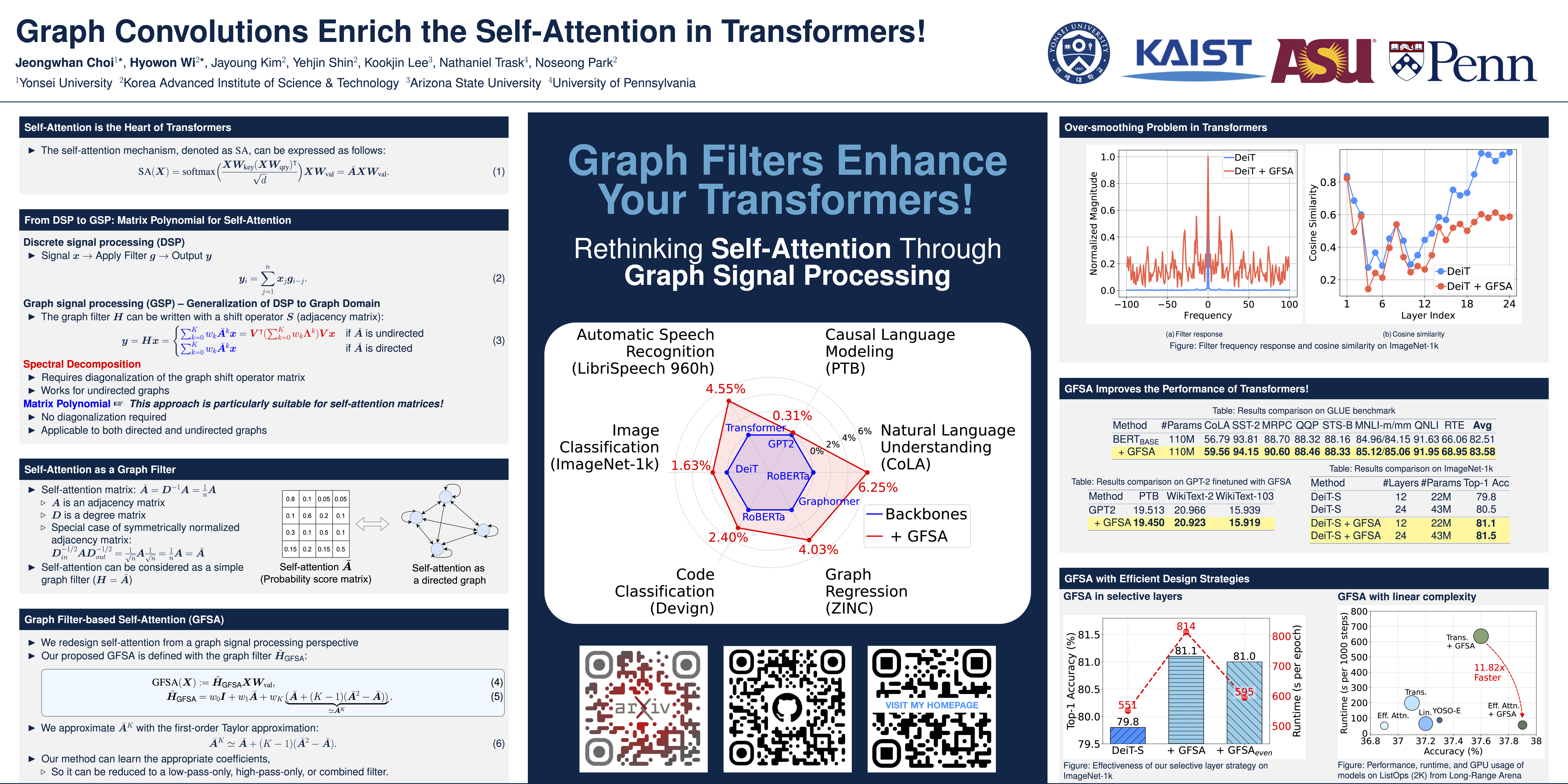
- Graph Filter-based Self-Attention (GFSA) is a novel approach to enhance the self-attention mechanism in Transformers.
- By redesigning self-attention from a graph signal processing (GSP) perspective, GFSA addresses the oversmoothing problem and improves performance for various domains.
Key Features:
- Easily integrates with existing Transformer models
- Improves performance with minimal computational overhead
- GFSA shows significant improvements across various tasks on multiple domains

Tasks and Directories
The detailed guidance is included in the README.md of each subdirectory:
-
🖼️ Image Classification 👉
./Image -
📚 Natural Language Understanding 👉
./NLP -
🧠 Causal Language Modeling 👉
./NLP -
🌐 Graph Regression 👉
./Graph -
🎙️ Speech Recognition 👉
./Speech -
💻 Code Classification 👉
./Code
Implementation Example with the Pseudocode
GFSA's core implementation is shown in the following pseudocode:
def GFSA(att, K):
    """
    Graph Filter-based Self-Attention

    Args:
        att: original self-attention matrix
        K: order of high-order term

    Notes:
        w_0, w_1 can be set in two ways:
        1) As learnable parameters
        2) Fixed as hyperparameters (w_0=0, w_1=1)

    Returns:
        gf_att: GFSA attention matrix
    """
    # Initialize weights
    w_0 = torch.zeros(h)  # identity term weight
    w_1 = torch.ones(h)   # first-order term weight
    w_K = torch.zeros(h)  # high-order term weight
    I = torch.eyes(n)[None, None, ...]

    # Compute high-order term using Taylor approximation
    att_K = att + (K-1) * (torch.mm(att,att) - att)

    # Combine terms with weights
    gf_att = w_0[None, :, None, None] * I + \
             w_1[None, :, None, None] * att + \
             w_K[None, :, None, None] * att_K

    return gf_att
Key Implementation Features
- Weight Initialization:
w_0,w_1can be either learnable parameters or fixed hyperparameters - High-order Term: Uses Taylor approximation to reduce computational cost
- Minimal Parameters: Adds only a small number of parameters compared to base models
Integration Example
from models.attention import GFSA

# Replace original self-attention with GFSA
attention_output = GFSA(
    att=attention_scores,  # original attention matrix
    K=3                    # order of high-order term
)
Citation
If you use this code for your research, please cite our paper:
@inproceedings{choi2024gfsa,
   title={Graph Convolutions Enrich the Self-Attention in Transformers!},
   author={Jeongwhan Choi and Hyowon Wi and Jayoung Kim and Yehjin Shin and Kookjin Lee and Nathaniel Trask and Noseong Park},
   booktitle={The Thirty-eighth Annual Conference on Neural Information Processing Systems},
   year={2024},
   url={https://openreview.net/forum?id=ffNrpcBpi6}
}