fossable/goldboot
Build golden images with CI






People usually don't reinstall their OS from scratch very often. When they do,
chaos ensues the moment they reach that pristine desktop or terminal. Settings
get changed, applications are installed, bloatware is removed, files are
downloaded here and there. The system is generally altered from its original
state into a new "customized" state by a manual flurry of mouse clicks and key
presses.
This standard approach is like mutable infrastructure, meaning you mutate the
state of your system repeatedly until it eventually suits your needs. And when
something goes awry, you have to make the necessary changes to get it back in
line.
For most people, mutable infrastructure works out fine until something major
breaks or they have to migrate to a new computer altogether. In these cases,
they probably end up starting over from scratch and reapply their changes again
(and probably slightly differently this time).
Sophisticated computer elites probably practice immutable infrastructure.
Meaning that, every time they boot their system, its state begins almost
identically to the time before. Any changes that are made during the course of
runtime vanish on reboot. This approach has some real benefits, but requires
quite a bit of effort from the user.
goldboot is a tool that builds machine images for real hardware that can help
you achieve something close to immutable infrastructure without creating a lot
of extra work for yourself.
In the goldboot approach, you create a declarative configuration file for each
machine that you want to deploy. Using this configuration, goldboot builds an
image either on your local machine or on a CI platform like Github Actions. The
resulting image can be deployed to real hardware via a USB drive or through PXE
boot.
Warning: this tool is totally unfinshed and should be used for testing only!
Proceed at your own risk!
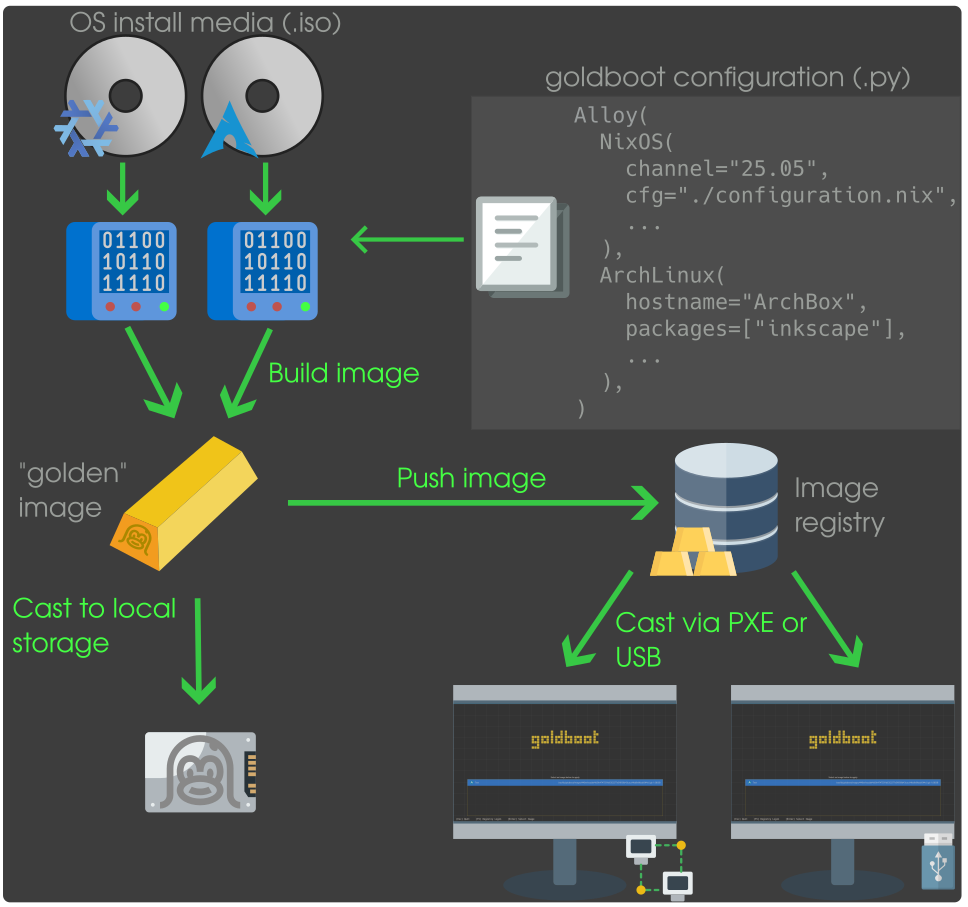
goldboot is approximately what you would get if
docker and packer were
mixed together. Instead of building containers or virtual machines, goldboot
builds images for real hardware.
These machine images (also known as golden images) contain your operating
system(s), applications, software patches, and configuration all rolled into one
easily deployable package.
Like Docker images, your goldboot images can be stored in a registry and
pulled onto real hardware.
Installation
Docker



Install from DockerHub
alias goldboot="docker run --rm -v .:/root fossable/goldboot"Crates.io

Install from crates.io
cargo install goldbootArch Linux



Install from the AUR
  cd /tmp
  curl https://aur.archlinux.org/cgit/aur.git/snapshot/goldboot.tar.gz | tar xf -
  makepkg -si
Nixpkgs
Install from nixpkgs
nix-shell -p goldbootGithub Releases

Install manually from Github releases
curl -o /usr/bin/goldboot https://github.com/fossable/goldboot/releases/download/goldboot-v0.0.7/goldboot_<platform>
chmod +x /usr/bin/goldboot
Dependencies
apt-get install -y libudev1 libgtk-4-1 libglib2.0-0Github Actions
Running on Github actions
Building golden images with CI is common practice, so there's also a
Github action to make it easy:
steps:
  - name: Checkout
    uses: actions/checkout@v4

  - name: Build goldboot image
    uses: fossable/goldboot-action@main
    with:
      config-path: goldboot.json
      output-path: image.gb

  - name: Save image artifact
    uses: actions/upload-artifact@v3
    with:
      name: my_image.gb
      path: image.gb
Examples
The goldboot-examples repo
contains example configurations of all supported OS types and system
architectures. They are built on a weekly schedule against the latest version of
goldboot.
| Linux | Windows | macos |
|---|---|---|
  |
  |
  |
  |
||
  |
||
  |
||
  |
||
  |
Example walkthrough
Let's build a basic Arch Linux
image to prove we're
real Linux users.
First, create a directory to hold our configuration (which can later be tracked
in version control):
mkdir Test && cd TestInitialize the directory and choose ArchLinux to start with:
goldboot init \
  --name Test \
  --os ArchLinux \
  --size 10G \
  --format json
This will create goldboot.json which contains configuration options that can
be tweaked to suit your needs. For example:
{
  "alloy": [
    {
      "os": {
        "ArchLinux": {
          "hostname": "YeahIUseArch",
          "root_password": {
            "plaintext": "123456"
          }
        }
      },
      "source": {
        "Iso": {
          "url": "https://mirrors.edge.kernel.org/archlinux/iso/2024.01.01/archlinux-2024.01.01-x86_64.iso",
          "checksum": "sha256:12addd7d4154df1caf5f258b80ad72e7a724d33e75e6c2e6adc1475298d47155"
        }
      }
    }
  ],
  "arch": "Amd64",
  "name": "Test",
  "size": "10G"
}
There are many ways to customize the image, but for now just build it:
goldboot build .Once the build succeeds, the image will be saved to the system's library
directory. To deploy it to a physical disk, you can include the image on a new
bootable USB drive:
# THIS WILL OVERWRITE /dev/sdX!
goldboot liveusb --output /dev/sdX --include Test
Once the USB is created, you can use it to boot into the goldboot live
environment and select an image to deploy:
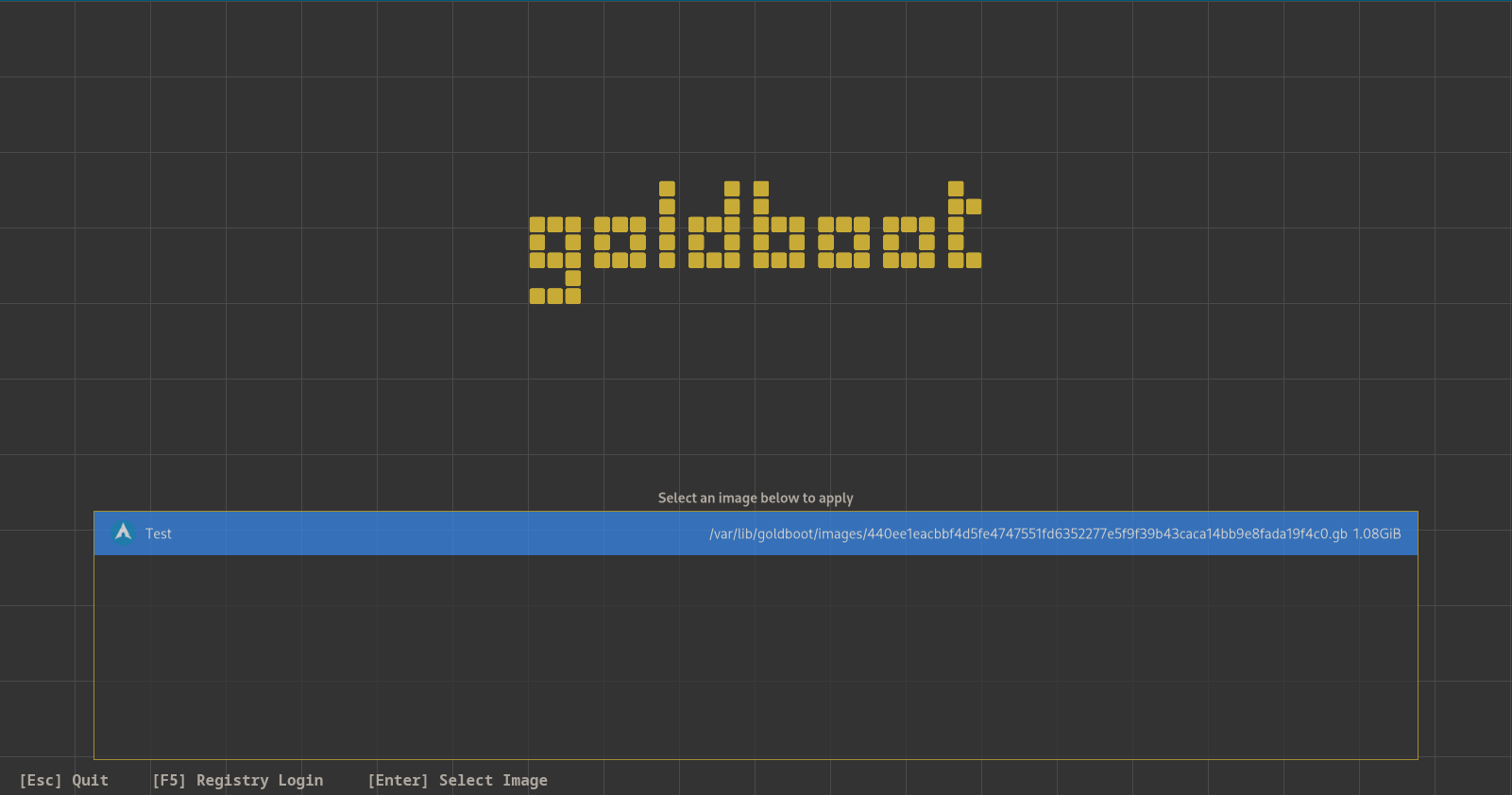
Once the image has been deployed, remove the bootable USB drive and reboot the
machine.