GUAC: Graph for Understanding Artifact Composition

⚠️ GUAC is being re-architected to support GraphQL: the main branch
has breaking changes. Please use
release v0.0.1 until
work is complete!
Note: GUAC is under active development - if you are interested in
contributing, please look at contributor guide and the
"express interest" issue
Graph for Understanding Artifact Composition (GUAC) aggregates software security
metadata into a high fidelity graph database—normalizing entity identities and
mapping standard relationships between them. Querying this graph can drive
higher-level organizational outcomes such as audit, policy, risk management, and
even developer assistance.
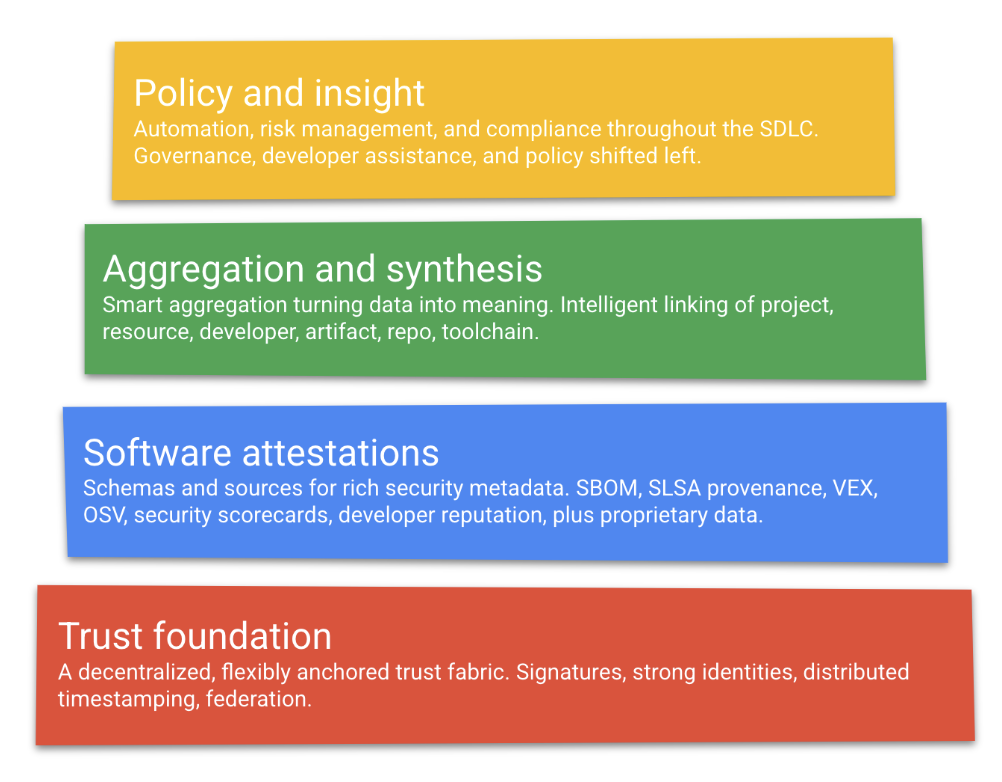
Conceptually, GUAC occupies the “aggregation and synthesis” layer of the
software supply chain transparency logical model:
A few examples of questions answered by GUAC include:

Quickstart
Refer to the Setup + Demo document to learn how to prepare your
environment and try GUAC out!
Architecture
Here is an overview of the architecture of GUAC:

Supported input formats
Note that GUAC uses software identifiers standards to help link metadata
together. However, these identifiers are not always available and heuristics
need to be used to link them. Therefore, there may be unhandled edge cases and
errors occuring when ingesting data. We appreciate if a comment can be made on
the metadata quality issue.
Additional References
Communication
We encourage discussions to be done on github issues. We also have a
public slack channel on the
OpenSSF slack.
For future updates, announcements, and community meetings, join our
GUAC community google group.
We host monthly community calls available for all to join
(Calendar Invite).
For security issues or code of conduct concerns, an e-mail should be sent to
guac-maintainers@googlegroups.com.
Governance
Information about governance can be found here.