MariiaZimokha/sorting-algorithms-in-javascript
Sorting algorithms in javascript
sorting-algorithms-in-javascript
Sorting algorithms in javascript
Time complexity
| Name | Best | Average | Worst |
|---|---|---|---|
| Quick | O(n Logn) | O(n Logn) | O(n^2) |
| Merge | O(n Logn) | O(n Logn) | O(n Logn) |
| Bubble | O(n) | O(n^2) | O(n^2) |
| Insertion | O(n) | O(n^2) | O(n^2) |
| Selection | O(n^2) | O(n^2) | O(n^2) |
Merge Sort
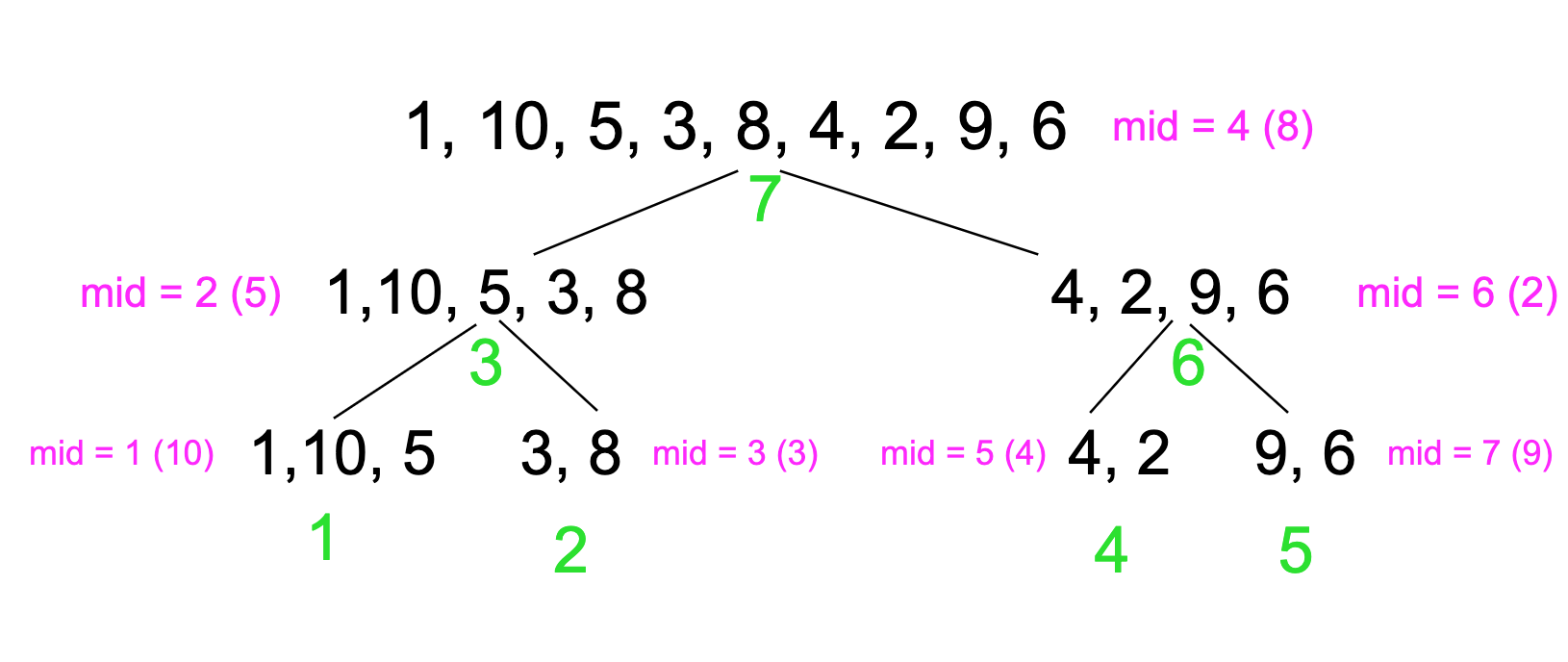
The idea of merge sort:
It divides input array in two halves, calls itself for the two halves and then merges the two sorted halves. The merge() function is used for merging two halves. The merge(arr, start, end, mid) is key process that assumes that arr[start..mid] and arr[mid+1..end] are sorted and merges the two sorted sub-arrays into one.
Green numbers indicate the order in which steps are processed
Selection Sort
The idea of seletion sort:
- in iteration i, find the index min of smallest remaining entry
- swap a[i] and a[min]
Input array: [7, 10, 5, 3, 8, 4, 2, 9, 6]
| Step | Visualization |
|---|---|
| min is 2, swap with a[0] | [2, 10, 5, 3, 8, 4, 7, 9, 6] |
| min is 3, swap with a[1] | [2, 3, 5, 10, 8, 4, 7, 9, 6] |
| min is 4, swap with a[2] | [2, 3, 4, 10, 8, 5, 7, 9, 6] |
| min is 5, swap with a[3] | [2, 3, 4, 5, 8, 10, 7, 9, 6] |
| min is 6, swap with a[4] | [2, 3, 4, 5, 6, 10, 7, 9, 8] |
| min is 7, swap with a[5] | [2, 3, 4, 5, 6, 7, 10, 9, 8] |
| min is 8, swap with a[6] | [2, 3, 4, 5, 6, 7, 8, 9, 10] |
| min is 9, swap with a[7] | [2, 3, 4, 5, 6, 7, 8, 9, 10] |
| min is 10, swap with a[8] | [2, 3, 4, 5, 6, 7, 8, 9, 10] |
Selection sort uses (N - 1) + (N - 2) + (N - 3) + ... + 2 + 1 + 0 ~ (N^2)/2 compares
and exchanges. It can be seen in the table above.
Implantation is here
Insertion Sort
The idea of seletion sort:
- in iteration i, swap a[i] with each larger entry to its left
Input array: [7, 10, 5, 3, 8, 4, 2, 9, 6]
| Step | Visualization |
|---|---|
| 7 is in order | [7, 10, 5, 3, 8, 4, 2, 9, 6] |
| 10 is in order | [7, 10, 5, 3, 8, 4, 2, 9, 6] |
| 5 is smaller then 10 (swap them) 5 is smaller then 7 (swap them) |
[5, 7, 10, 3, 8, 4, 2, 9, 6] |
| 3 is smaller then 10 (swap them) 3 is smaller then 7 (swap them) 3 is smaller then 5 (swap them) |
[3, 5, 7, 10, 8, 4, 2, 9, 6] |
| 8 is smaller then 10 (swap them) | [3, 5, 7, 8, 10, 4, 2, 9, 6] |
| 4 is smaller then 10 (swap them) 4 is smaller then 8 (swap them) 4 is smaller then 7 (swap them) 4 is smaller then 5 (swap them) |
[3, 4, 5, 7, 8, 10, 2, 9, 6] |
| 2 is smaller then 10 (swap them) 2 is smaller then 8 (swap them) 2 is smaller then 7 (swap them) 2 is smaller then 5 (swap them) 2 is smaller then 4 (swap them) 2 is smaller then 3 (swap them) |
[2, 3, 4, 5, 7, 8, 10, 9, 6] |
| 9 is smaller then 10 (swap them) | [2, 3, 4, 5, 7, 8, 9, 10, 6] |
| 6 is smaller then 10 (swap them) 6 is smaller then 9 (swap them) 6 is smaller then 8 (swap them) 6 is smaller then 7 (swap them) |
[2, 3, 4, 5, 6, 7, 8, 9, 10] |
To sort randomly-ordered array with distinct keys, insertion sort uses ~ 1/4 N^2 compares and ~ 1/4 N^2 exchanges on average.
Best case. If the array is in ascending order, insertion sort makes N-1 compares and 0 exchanges.
Worst case. If the array is in descending order (and no duplicates), insertion sort makes ~1/2 N^2 compares and ~1/2 N^2 exchanges.
Proposition For partially-sorted array, insertion sort runs in linear time.
Proof Number of exchanges equals the number of inversions. (number of compares = exchanges + (N - 1))
Implantation is here
Bubble sort
The idea of seletion sort:
- in iteration i, swap a[i] with each larger entry to its left
Input array: [7, 10, 5, 3, 8, 4, 2, 9, 6]
| Step | Visualization |
|---|---|
| first iteration | |
| 7 < 10 | [7, 10, 5, 3, 8, 4, 2, 9, 6] |
| 10 > 5, swap | [7, 5, 10, 3, 8, 4, 2, 9, 6] |
| 10 > 3, swap | [7, 5, 3, 10, 8, 4, 2, 9, 6] |
| 10 > 8, swap | [7, 5, 3, 8, 10, 4, 2, 9, 6] |
| 10 > 4, swap | [7, 5, 3, 8, 4, 10, 2, 9, 6] |
| 10 > 2, swap | [7, 5, 3, 8, 4, 2, 10, 9, 6] |
| 10 > 9, swap | [7, 5, 3, 8, 4, 2, 9, 10, 6] |
| 10 > 6, swap | [7, 5, 3, 8, 4, 2, 9, 6, 10] |
| second iteration | |
| 7 > 5, swap | [5, 7, 3, 8, 4, 2, 9, 6, 10] |
| .... |
Best case. If the array is in descending order, bubbel sort uses O(N^2) comparisons for basic version and O(N) for the optimized one, O(1) exchanges
Worst case. If the array is in ascending order, bubble sort uses O(N^2) comparisons and O(n^2) exchanges
Implantation is here