DenChenn/size-limit
Calculate the real cost to run your JS app or lib to keep good performance. Show error in pull request if the cost exceeds the limit.
Size Limit 


Size Limit is a performance budget tool for JavaScript. It checks every commit
on CI, calculates the real cost of your JS for end-users and throws an error
if the cost exceeds the limit.
- ES modules and tree-shaking support.
- Add Size Limit to Travis CI, Circle CI, GitHub Actions
or another CI system to know if a pull request adds a massive dependency. - Modular to fit different use cases: big JS applications
that use their own bundler or small npm libraries with many files. - Can calculate the time it would take a browser
to download and execute your JS. Time is a much more accurate
and understandable metric compared to the size in bytes. - Calculations include all dependencies and polyfills
used in your JS.

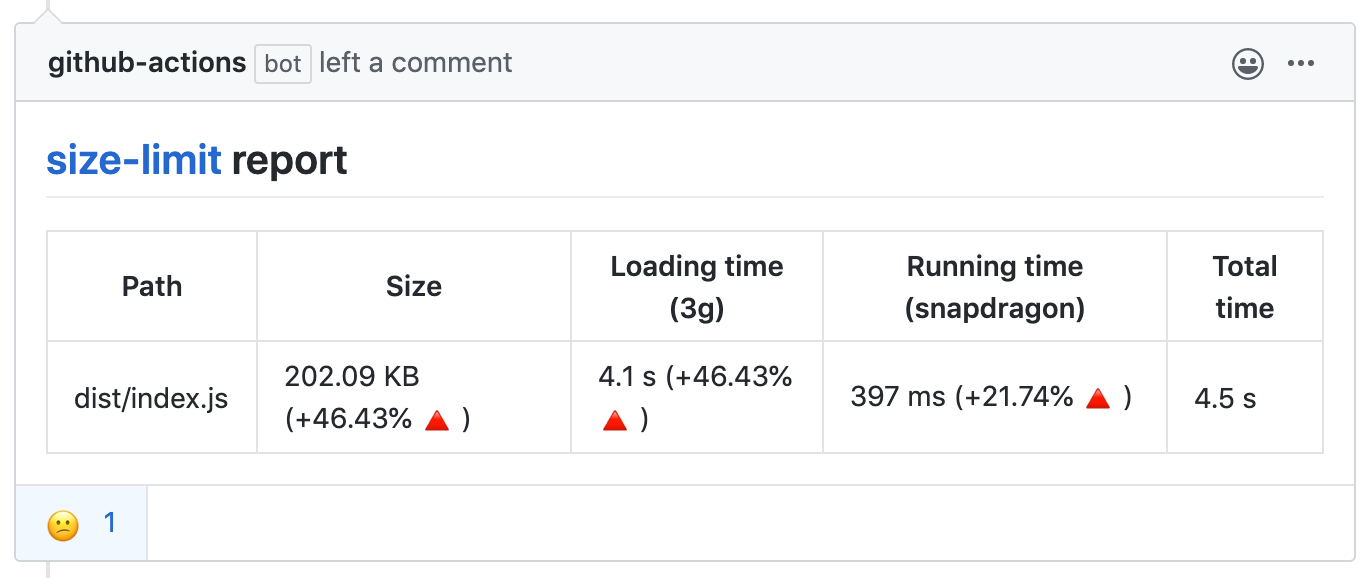
With GitHub action Size Limit will post bundle size changes as a comment
in pull request discussion.
With --why, Size Limit can tell you why your library is of this size
and show the real cost of all your internal dependencies.
We are using Statoscope for this analysis.


Who Uses Size Limit
- MobX
- Material-UI
- Autoprefixer
- PostCSS reduced
25% of the size. - Browserslist reduced
25% of the size. - EmojiMart reduced
20% of the size - nanoid reduced
33% of the size. - React Focus Lock reduced
32% of the size. - Logux reduced
90% of the size.
How It Works
- Size Limit contains a CLI tool, 3 plugins (
file,webpack,time)
and 3 plugin presets for popular use cases (app,big-lib,small-lib).
A CLI tool finds plugins inpackage.jsonand loads the config. - If you use the
webpackplugin, Size Limit will bundle your JS files into
a single file. It is important to track dependencies and webpack polyfills.
It is also useful for small libraries with many small files and without
a bundler. - The
webpackplugin creates an empty webpack project, adds your library
and looks for the bundle size difference. - The
timeplugin compares the current machine performance with that of
a low-priced Android devices to calculate the CPU throttling rate. - Then the
timeplugin runs headless Chrome (or desktop Chrome if it’s
available) to track the time a browser takes to compile and execute your JS.
Note that these measurements depend on available resources and might
be unstable. See here
for more details.
Usage
JS Applications
Suitable for applications that have their own bundler and send the JS bundle
directly to a client (without publishing it to npm). Think of a user-facing app
or website, like an email client, a CRM, a landing page or a blog with
interactive elements, using React/Vue/Svelte lib or vanilla JS.
Show instructions
-
Install the preset:
$ npm install --save-dev size-limit @size-limit/file
-
Add the
size-limitsection and thesizescript to yourpackage.json:+ "size-limit": [ + { + "path": "dist/app-*.js" + } + ], "scripts": { "build": "webpack ./webpack.config.js", + "size": "npm run build && size-limit", "test": "jest && eslint ." }
-
Here’s how you can get the size for your current project:
$ npm run size

  Package size: 30.08 kB with all dependencies, minified and gzipped
-
Now, let’s set the limit. Add 25% to the current total size and use that as
the limit in yourpackage.json:"size-limit": [ { + "limit": "35 kB", "path": "dist/app-*.js" } ], -
Add the
sizescript to your test suite:"scripts": { "build": "webpack ./webpack.config.js", "size": "npm run build && size-limit", - "test": "jest && eslint ." + "test": "jest && eslint . && npm run size" } -
If you don’t have a continuous integration service running, don’t forget
to add one — start with Travis CI.
JS Application and Time-based Limit
File size limit (in kB) is not the best way to describe your JS application
cost for developers. Developers will compare the size of the JS bundle
with the size of images. But browsers need much more time to parse 100 kB
of JS than 100 kB of an image since JS compilers are very complex.
This is why Size Limit support time-based limit. It runs headless Chrome
to track the time a browser takes to compile and execute your JS.
Show instructions
-
Install the preset:
$ npm install --save-dev size-limit @size-limit/preset-app
-
Add the
size-limitsection and thesizescript to yourpackage.json:+ "size-limit": [ + { + "path": "dist/app-*.js" + } + ], "scripts": { "build": "webpack ./webpack.config.js", + "size": "npm run build && size-limit", "test": "jest && eslint ." }
-
Here’s how you can get the size for your current project:
$ npm run size

  Package size: 30.08 kB with all dependencies, minified and gzipped
  Loading time: 602 ms   on slow 3G
  Running time: 214 ms   on Snapdragon 410
  Total time:   815 ms
-
Now, let’s set the limit. Add 25% to the current total time and use that as
the limit in yourpackage.json:"size-limit": [ { + "limit": "1 s", "path": "dist/app-*.js" } ], -
Add the
sizescript to your test suite:"scripts": { "build": "webpack ./webpack.config.js", "size": "npm run build && size-limit", - "test": "jest && eslint ." + "test": "jest && eslint . && npm run size" } -
If you don’t have a continuous integration service running, don’t forget
to add one — start with Travis CI.
Big Libraries
JS libraries > 10 kB in size.
This preset includes headless Chrome, and will measure your lib’s execution
time. You likely don’t need this overhead for a small 2 kB lib, but for larger
ones the execution time is a more accurate and understandable metric that
the size in bytes. Library like React is a good example for this preset.
Show instructions
-
Install preset:
$ npm install --save-dev size-limit @size-limit/preset-big-lib
-
Add the
size-limitsection and thesizescript to yourpackage.json:+ "size-limit": [ + { + "path": "dist/react.production-*.js" + } + ], "scripts": { "build": "webpack ./scripts/rollup/build.js", + "size": "npm run build && size-limit", "test": "jest && eslint ." }
-
If you use ES modules you can test the size after tree-shaking with
import
option:"size-limit": [ { "path": "dist/react.production-*.js", + "import": "{ createComponent }" } ], -
Here’s how you can get the size for your current project:
$ npm run size

  Package size: 30.08 kB with all dependencies, minified and gzipped
  Loading time: 602 ms   on slow 3G
  Running time: 214 ms   on Snapdragon 410
  Total time:   815 ms
-
Now, let’s set the limit. Add 25% to the current total time and use that
as the limit in yourpackage.json:"size-limit": [ { + "limit": "1 s", "path": "dist/react.production-*.js" } ], -
Add a
sizescript to your test suite:"scripts": { "build": "rollup ./scripts/rollup/build.js", "size": "npm run build && size-limit", - "test": "jest && eslint ." + "test": "jest && eslint . && npm run size" } -
If you don’t have a continuous integration service running, don’t forget
to add one — start with Travis CI. -
Add the library size to docs, it will help users to choose your project:
  # Project Name

  Short project description

  * **Fast.** 10% faster than competitor.
+ * **Small.** 15 kB (minified and gzipped).
+   [Size Limit](https://github.com/ai/size-limit) controls the size.
Small Libraries
JS libraries < 10 kB in size.
This preset will only measure the size, without the execution time, so it’s
suitable for small libraries. If your library is larger, you likely want
the Big Libraries preset above. Nano ID or Storeon are good examples
for this preset.
Show instructions
-
First, install
size-limit:$ npm install --save-dev size-limit @size-limit/preset-small-lib
-
Add the
size-limitsection and thesizescript to yourpackage.json:+ "size-limit": [ + { + "path": "index.js" + } + ], "scripts": { + "size": "size-limit", "test": "jest && eslint ." }
-
Here’s how you can get the size for your current project:
$ npm run size

  Package size: 177 B with all dependencies, minified and gzipped
-
If your project size starts to look bloated, run
--whyfor analysis:$ npm run size -- --why
We use Statoscope as bundle analyzer.
-
Now, let’s set the limit. Determine the current size of your library,
add just a little bit (a kilobyte, maybe) and use that as the limit
in yourpackage.json:"size-limit": [ { + "limit": "9 kB", "path": "index.js" } ], -
Add the
sizescript to your test suite:"scripts": { "size": "size-limit", - "test": "jest && eslint ." + "test": "jest && eslint . && npm run size" } -
If you don’t have a continuous integration service running, don’t forget
to add one — start with Travis CI. -
Add the library size to docs, it will help users to choose your project:
  # Project Name

  Short project description

  * **Fast.** 10% faster than competitor.
+ * **Small.** 500 bytes (minified and gzipped). No dependencies.
+   [Size Limit](https://github.com/ai/size-limit) controls the size.
Reports
Size Limit has a GitHub action that comments and rejects pull requests based
on Size Limit output.
- Install and configure Size Limit as shown above.
- Add the following action inside
.github/workflows/size-limit.yml
name: "size"
on:
  pull_request:
    branches:
      - master
jobs:
  size:
    runs-on: ubuntu-latest
    env:
      CI_JOB_NUMBER: 1
    steps:
      - uses: actions/checkout@v1
      - uses: andresz1/size-limit-action@v1
        with:
          github_token: ${{ secrets.GITHUB_TOKEN }}
Config
Size Limits supports three ways to define config.
-
size-limitsection inpackage.json:"size-limit": [ { "path": "index.js", "import": "{ createStore }", "limit": "500 ms" } ]
-
or a separate
.size-limit.jsonconfig file:[ { "path": "index.js", "import": "{ createStore }", "limit": "500 ms" } ]
-
or a more flexible
.size-limit.jsor.size-limit.cjsconfig file:module.exports = [ { path: "index.js", import: "{ createStore }", limit: "500 ms" } ]
Each section in the config can have these options:
- path: relative paths to files. The only mandatory option.
It could be a path"index.js", a pattern"dist/app-*.js"
or an array["index.js", "dist/app-*.js", "!dist/app-exclude.js"]. - import: partial import to test tree-shaking. It could be
"{ lib }"
to testimport { lib } from 'lib'or{ "a.js": "{ a }", "b.js": "{ b }" }
to test multiple files. - limit: size or time limit for files from the
pathoption. It should be
a string with a number and unit, separated by a space.
Format:100 B,10 kB,500 ms,1 s. - name: the name of the current section. It will only be useful
if you have multiple sections. - entry: when using a custom webpack config, a webpack entry could be given.
It could be a string or an array of strings.
By default, the total size of all entry points will be checked. - webpack: with
falseit will disable webpack. - running: with
falseit will disable calculating running time. - gzip: with
falseit will disable gzip compression. - brotli: with
trueit will use brotli compression and disable
gzip compression. - config: a path to a custom webpack config.
- ignore: an array of files and dependencies to exclude from
the project size calculation. - modifyWebpackConfig: (.size-limit.js only) function that can be used
to do last-minute changes to the webpack config, like adding a plugin. - compareWith: path to
stats.jsonfrom another build to compare
(when--whyis using). - uiReports: custom UI reports list (see Statoscope docs).
If you use Size Limit to track the size of CSS files, make sure to set
webpack: false. Otherwise, you will get wrong numbers, because webpack
inserts style-loader runtime (≈2 kB) into the bundle.
Plugins and Presets
Plugins:
@size-limit/filechecks the size of files with Gzip, Brotli
or without compression.@size-limit/webpackadds your library to empty webpack project
and prepares bundle file forfileplugin.@size-limit/webpack-whyadds reports forwebpackplugin
about your library is of this size to show the cost of all your
dependencies.@size-limit/webpack-cssadds css support forwebpackplugin.@size-limit/esbuildis likewebpackplugin, but usesesbuild
to be faster and use less space innode_modules.@size-limit/timeuses headless Chrome to track time to execute JS.@size-limit/dual-publishcompiles files to ES modules withdual-publish
to check size after tree-shaking.
Plugin presets:
@size-limit/preset-appcontainsfileandtimeplugins.@size-limit/preset-big-libcontainswebpack,file, andtimeplugins.@size-limit/preset-small-libcontainsesbuildandfileplugins.
JS API
const sizeLimit = require('size-limit')
const filePlugin = require('@size-limit/file')
const webpackPlugin = require('@size-limit/webpack')

sizeLimit([filePlugin, webpackPlugin], [filePath]).then(result => {
  result //=> { size: 12480 }
})